
Vacuum sealing is part of the daily routine in many professional kitchens, but packing a portion of fish is not the same task as sealing sauce or preparing dozens of portions for service. Your choice of machine starts with these different jobs and how they fit into the team's workflow.
Start with the food and the workflow
Make a short list of typical jobs before comparing machines: individual portions of fish, batches of prepared vegetables, bags of sauce or ingredients destined for sous-vide cooking. Record the largest portion and bag, then count how many packs need sealing during your busiest preparation period. A machine that fits one bag comfortably may still slow a team down if several bags must be packed in sequence.
Consider where packing happens, too. Staff need room to fill bags, keep the sealing area clean and set finished packs aside for labelling. Check the machine’s external dimensions as well as its chamber dimensions; a floor-standing unit changes the layout differently from a countertop model.
Sauces, marinades or dry portions?
An external suction sealer draws air through the open end of a bag. It can be a compact option for occasional dry-food packing, but free-flowing liquid can be pulled towards the seal or into the machine. A chamber vacuum sealer removes air from the enclosed chamber, making liquid-rich foods easier to manage when the bag is filled and positioned correctly.
The RVSVoordeel machines compared below are chamber models, not external suction sealers. If sauces or marinades are part of your routine, a chamber is worth considering; if you mainly pack dry portions, compare the space and workload requirements rather than assuming you need the biggest chamber available.
Measure the bag, chamber and seal bar separately
A seal-bar length is not the same as the maximum usable bag size. The bag must also sit inside the chamber, with its open edge lying flat across the bar. Check chamber height for bulky portions and allow space above the food so liquid or crumbs do not contaminate the sealing area.
These examples show why the three measurements matter. Dimensions and maximum bag sizes below are those listed for each specific model; confirm them against the bags you intend to use.
| Machine | Chamber and seal bar | Listed maximum bag | Practical fit |
|---|---|---|---|
| 26 cm tabletop chamber model | 28 × 38.5 × 9 cm; 26 cm bar | 25 × 40 cm | Smaller portions where counter space is available |
| 29 cm oil-free chamber model | 35 × 30 × 11 cm; 29 cm bar | 30 × 40 cm | Countertop packing with an oil-free pump |
| 40 cm floor-standing chamber model | 42 × 44 × 20 cm; 40 cm bar | 30 × 40 cm | Taller contents and a dedicated packing position |
| 60 cm double-chamber model | Two 76 × 60 × 16 cm chambers; two 60 cm bars per chamber | 50 × 55 cm | Batch packing where multiple bags are prepared together |
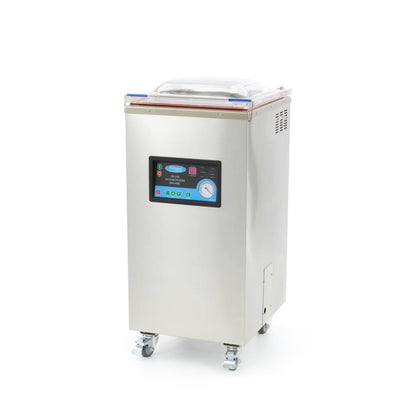
Notice that the 40 cm model lists a larger chamber and longer seal bar than the 29 cm model, yet both list a maximum bag of 30 × 40 cm. Do not choose from the number in the product title alone. Take a sample of your largest intended bag and check its orientation, filled thickness and clear space at the seal.
What slows down packing during a busy shift?
Pump capacity, expressed in cubic metres per hour, describes air-moving capacity; it does not tell you how many finished packs a team will produce per hour. Bag filling, positioning, sealing, cooling and labelling also take time. Compare the full workflow if faster throughput is the reason for upgrading.
For example, the 26 cm tabletop model lists a 10 m³/h pump, while the 29 cm model lists a 4.5 m³/h oil-free pump. The oil-free design is a meaningful maintenance distinction, not proof that one model will finish every job faster. The 60 cm model has two chambers, two seal bars per chamber and two pumps with a combined listed capacity of 40 m³/h; that layout is most relevant when staff can prepare enough bags to use it.
Check bags and the seal you actually need
Choose bags that suit both the machine and the food’s intended use. The listed maximum bag dimensions are an upper limit, not a recommendation to use that size for every portion. Smaller, appropriately sized bags can be easier to load neatly and leave less unnecessary material around the product.
- Confirm the bag opening fits flat along the seal bar, without folds or food in the sealing zone.
- Check that the bag material is specified for its intended storage and, if relevant, cooking temperatures; do not assume every vacuum bag is suitable for sous-vide cooking.
- Allow enough clean, empty bag above wet or bulky food to make a reliable seal.
- Inspect a finished pack for wrinkles, trapped residue or an incomplete seal before labelling it.
If you are comparing a chamber machine with an external suction sealer, check bag compatibility rather than buying bags by size alone. Different sealing methods may require different bag construction, so verify the requirements of the particular machine and consumables.
Build food safety into the decision
Vacuum packing is a packaging step, not a substitute for chilling, hygiene or a validated shelf life. Removing air can reduce some forms of deterioration while also creating conditions in which certain harmful bacteria can grow. Set storage conditions and dates through your food-safety procedures, not through a generic claim that vacuum-packed food lasts a fixed number of days.
Keep raw and ready-to-eat foods separated during preparation, clean the machine between incompatible tasks and label packs so staff can identify contents and packing dates. For chilled or sous-vide products, assess the full process—including cooling, storage temperature and intended shelf life—under the food-safety requirements that apply to your operation.
Which setup fits your kitchen?
These three examples help translate technical details into real work:
- Small prep station: if you pack individual, relatively compact portions, a countertop chamber machine may keep the station simple. Check the filled bag size and counter space first.
- Wet ingredients and sauces: a chamber machine is easier to work with than an external suction sealer for liquid-rich foods, provided you load and seal the bags correctly.
- Large batches: a double-chamber model makes more sense when the team can prepare and handle enough bags to keep both chambers in use. More capacity alone does not speed up filling or labelling.
Which details matter before ordering?
First decide what you pack most often: dry portions, moist products, or high-volume batches. Then check which chamber and bag size suits that work, how the machine fits at the packing station, and whether the pump and sealing arrangement match your shift. Use the comparison table to narrow the range, and check the chosen model's specifications and bag compatibility before ordering.