

A commercial dishwasher has to keep up with service, not just fit into an available gap. The right choice depends on what you wash, how many racks arrive at the busiest moment and whether the kitchen can support the machine’s water, drainage and electrical requirements.
Start with the busiest hour
Count racks during a representative peak rather than dividing a day’s dishes evenly across opening hours. A restaurant may have a concentrated rush of plates after lunch, while a bar needs a steady supply of clean glasses throughout the evening. Note the mix of plates, glasses, cutlery and larger items, then identify which load actually holds up service.
Basket size is as important as programme length. A smaller rack may suit a compact wash area but require more loads; a larger rack is useful only if the dishes fit and staff have room to load and unload it. Also check the stated maximum item height, particularly for tall glasses or large plates.
Practical tip: put an empty rack where the machine would stand, then walk a dirty rack in and a clean rack out. If those routes cross, rethink the layout before choosing a faster machine.
Match the machine to the work
RVSVoordeel stocks distinct options for different wash areas, including glass washers, undercounter dishwashers and pass-through machines. This comparison describes where each format is worth considering; it is not a promise of how many racks your team will process per hour.
| Format | Consider it when | Check first |
|---|---|---|
| Glass washer | Glasses dominate the workload | Glass height and rack size |
| Undercounter dishwasher | Space is limited or loads are mixed | Door clearance and rack handling |
| Pass-through dishwasher | Racks need to move from dirty to clean sides | Open height and adjoining tables |
For a drinks-led wash area
A dedicated glass washer can make sense when bar glassware, rather than dinner plates, sets the pace. For example, the Maxima 35 × 35 cm glass washer has a stated maximum glass height of 19 cm. Check your tallest glasses against that limit rather than assuming every stemmed glass will fit.
For a compact or mixed wash area
An undercounter machine keeps the wash station relatively compact. The Maxima 40 × 40 cm undercounter dishwasher runs on 230 V and includes plate, glass and cutlery baskets. Its listed programmes are 135, 195 and 255 seconds; allow additional time for scraping, loading, unloading and bringing the machine up to operating temperature.
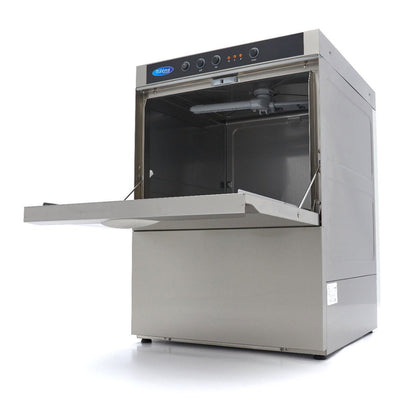
If larger racks better match the load, compare a 50 × 50 cm option rather than assuming a smaller machine will be quicker overall. The Maxima 50 × 50 cm undercounter dishwasher lists 100- and 190-second programmes, a maximum plate or glass height of 32.5 cm, and built-in drain, rinse-aid and detergent pumps. It requires a 400 V three-phase connection and is supplied without a plug, so installation needs checking in advance.
For a one-way flow of racks
A pass-through dishwasher can sit between dirty and clean sides of a wash area, making the direction of work clearer during a rush. The Maxima 50 × 50 cm pass-through dishwasher lists 55-, 105- and 195-second programmes and reaches 196 cm high when open. Confirm the available ceiling clearance, working space and table arrangement before treating its shortest cycle as the answer to a bottleneck.
Check the installation before comparing prices
Measure the full route into the wash area, the machine’s footprint and the clearance needed to open its door or hood. Leave workable space for a dirty-rack landing point and a clean-rack destination. A machine that fits under a counter on paper can still interrupt service if its open door blocks the aisle.
Check the specified electrical supply with a qualified installer, especially when comparing 230 V and 400 V models. Confirm the required water supply, inlet conditions and drainage arrangement for the exact machine. A built-in drain pump may matter where the outlet position makes gravity drainage unsuitable, but it does not remove the need to plan the drain correctly.
Consider running costs and cleaning routines
Compare the stated water use per cycle alongside programme choice and expected rack volume. The 40 × 40 cm undercounter model above lists 2.5 litres per cycle; the linked 50 × 50 cm undercounter and pass-through models each list 2.8 litres. Those figures do not, by themselves, describe total daily water or energy use: the number of cycles, start-up and time spent waiting between loads also matter.
Ask how detergent and rinse aid will be supplied and dosed. Included pumps differ between the linked models, so check the exact configuration instead of budgeting from a category name. Water hardness, suitable chemicals and the manufacturer’s descaling instructions also belong in the operating plan.
A short programme cannot compensate for food debris left on plates or a rack packed so tightly that water cannot reach the surfaces. Give staff a consistent routine:
- Scrape dishes and separate items that need a different rack or programme.
- Load so spray can reach each item without glasses or plates nesting together.
- Follow the machine’s operating instructions for chemicals, temperatures and daily cleaning.
- Empty and clean filters as directed, and deal promptly with limescale or poor rinse results.
Make the final choice
Write down your peak rack count, largest item, available footprint, open-door clearance and confirmed utilities. Then shortlist the format that suits the flow of work: a glass washer for a predominantly glassware station, an undercounter model for a compact mixed load, or a pass-through machine where racks can move cleanly from one side to the other. Compare the exact model’s baskets, pumps and programmes only after those practical requirements are met.